

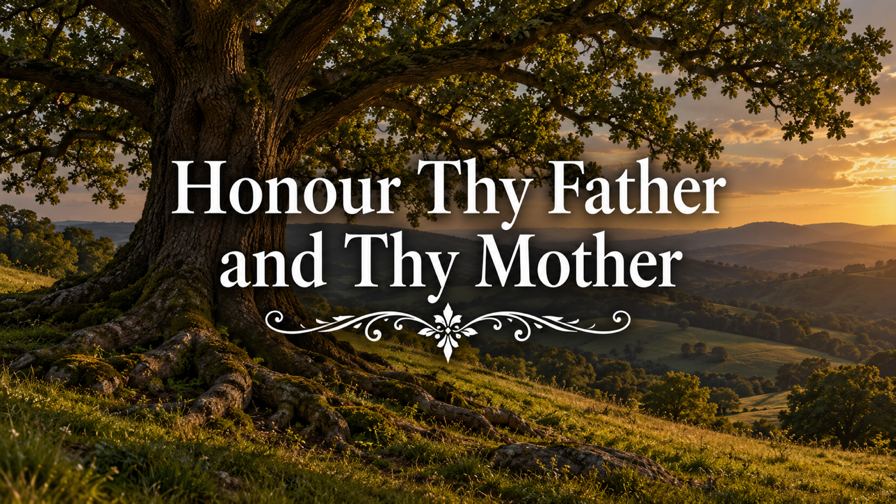
Honour Thy Father and Thy Mother
The first commandment with a promise
Brother Zeke Rivera read Exodus 20:1-12 with the congregation and preached from verse 12: "Honour thy father and thy mother, that thy days may be long upon the land which the Lord thy God giveth thee." Israel had just escaped slavery, he said, and the first thing God asked of His people after their freedom was to treat His words with weight. The message moved through three ideas: the weight of honor, the ways of honor, and the want of honor.
The weight of honor
Honor means treating something as heavy. The Hebrew word behind "honour" is kabed, which carries the idea of weight or heaviness. To honor a parent is to take their position, their person, and their words and not treat them lightly, like a crumpled piece of homework tossed aside. Brother Rivera turned to 1 Samuel 2:27-30, where Eli the priest honored his sons above God. His sons ate the sacrifices that belonged to the Lord, and Eli gave weight to their feelings and wishes instead of to God's command. God's answer: "them that honour me I will honour, and they that despise me shall be lightly esteemed."
The question this raises is where each person puts their weight. Some put it in friends, in experience, in education, or in how smart they are. Brother Rivera said that even a pastor's counsel carries nothing compared with the word of God, and it is easy to be satisfied hearing God's word through another man instead of opening the book and letting God speak. He urged the congregation to let the word of God read them, and not only to read it to quiet a conscience. To young people he said that God chose their parents or guardians, that some things in life are not ours to determine, and that the authority God placed over them is a matter between them and God, not only between them and their parents.
The ways of honor
Honor is expressed by obeying. Ephesians 6:1-3 says "children, obey your parents in the Lord, for this is right," and Colossians 3:20 adds "in all things, for this is well pleasing unto the Lord." Brother Rivera turned the point toward the adults: the command to obey a Father in heaven is for them, and if they followed God better, their children would follow them better. Citing 1 John 5:17, he said a believer cannot be satisfied with simply not doing wrong, because all unrighteousness is sin. Doing right matters more than how a person feels, and Christians should aim to be well pleasing to the Lord, God-fearing and not just moral.
Honor is expressed by receiving instruction. In Proverbs 1:1-9 the wise man hears and increases in learning, and he stays near wise counsel in order to understand proverbs and "dark sayings." Brother Rivera explained that a saying is dark when a young or inexperienced person cannot yet see its meaning, and time spent near older people makes it clear, a shortcut through mentorship. Verses 8 and 9 say a father's instruction and a mother's law are an ornament of grace and chains about the neck, so a life is beautified by honoring them.
He illustrated with a Lego Formula 1 car he once used with two teams. The team with the instructions built more than half of it in a few minutes, while the team without them fumbled with a few pieces. The world is in the same position, he said. People who lack God's instructions watch Christians who follow them and copy what they can, and a godly believer may then say, "I have the instructions, and you can have them too." That, he said, is how the church gets built. He told of a young man in Arizona who was reached because he saw a friend's life together and later took a bus aide job like the man who reached him. Brother Rivera added that no one has to be satisfied hearing God's instruction secondhand. Even a three-year-old in his junior church class brings a Bible, so they know it is not an accessory. The book of Proverbs also calls a person who rejects instruction a fool, he said, and that is a harsh word, not one to laugh off.
The want of honor
A lack of honor burdens God. In the King James, "want" means lack. Malachi 1:6-8 begins with the burden of the word of the Lord. God says that if He is a father, where is His honor, and the priests treated His altar as worthless and offered polluted bread. Brother Rivera linked this to Romans 12:1, where believers are to present their bodies a living sacrifice that is acceptable to God, not acceptable to themselves. What is acceptable to God is His will, so he asked directly: are you living in the will of God? If you are not honoring your father and your mother, he said, you are not.
He closed with two recent experiences that pressed this on him: a peer who drowned on a trip his own parents had begged him not to take, and the look on a sibling's face who regretted not listening to a parent earlier. The service ended with the altar open, an invitation to go to your Father in prayer and let Him search your heart, and a call for anyone unsure of their salvation to raise a hand.
























More Media Content
Live Service
Watch our live services during scheduled times. Join us for uplifting worship and inspiring sermons.
Listen to Music
Discover Christian music through our curated playlists and other recommended resources. Let the music uplift your spirit.