

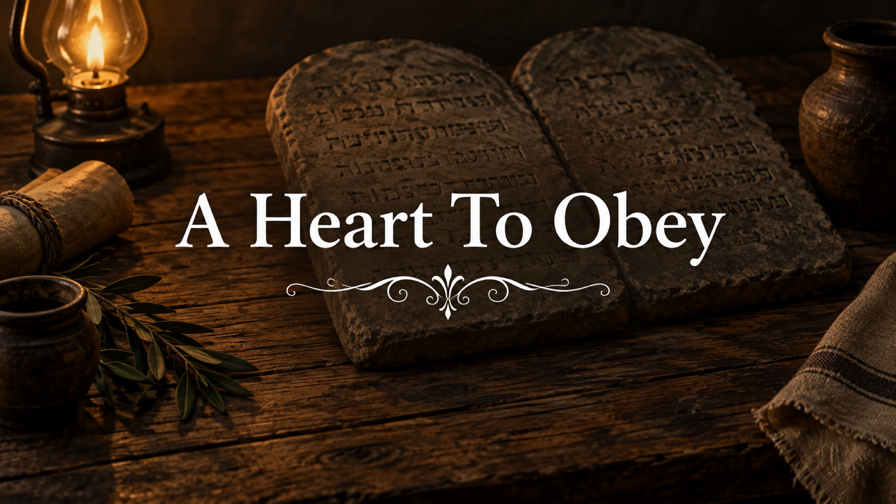
A Heart To Obey
Continuing through the commandments
Pastor Devon Ortiz picked up Deuteronomy 5 where the church left off the week before, walking through the second half of the Ten Commandments verse by verse and pressing on what each one actually asks of a person's heart, not just their behavior.
Honor your father and mother. Verse 16 comes with a promise attached, rare among the commandments, that it may go well and days be prolonged in the land. The pastor pointed out that honoring parents becomes far harder when a child's parents are not themselves honoring God, but the order of the commandments still stands: keep the Sabbath, honor your heavenly Father, and there is blessing attached to honoring the parents God gave you.
Thou shalt not kill. Verse 17 is stated with no elaboration, and the pastor called that starkness itself significant. Life belongs to God. It is not ours to take. He noted that Jesus later extends this in the New Testament to include hatred toward a brother, not because hating someone is identical to murder, but because it runs on the same line, and Christians need to be careful what they do with anger and bitterness before it curdles into something that puts them at odds with God.
Thou shalt not commit adultery. Verse 18 is about honoring commitments. Marriage, the pastor said, is not a contract but a covenant, and the difference matters: a contract is signed with someone you don't expect to keep it, a covenant is given to someone you want to honor.
Thou shalt not steal. Verse 19 led into a story from the church's own recent week. Their van was stolen about a month ago and recovered the next day, but the generator inside it was gone. Looking for a replacement microphone stand on Facebook Marketplace, the pastor spotted their own generator for sale, identifiable by gray paint that had spilled on the tire during a mission project. Newark PD arrived within minutes and recovered it. He tied the story back to the commandment directly: stealing takes what someone else worked and paid for and disrespects the effort behind it simply because taking it was easy.
Thou shalt not bear false witness. Verse 20 usually gets reduced to a rule against lying, but the pastor pushed past that. He said Christians who wouldn't tell an outright lie are often still very good at stretching the truth or omitting it, and the commandment as written specifically targets lies that damage a neighbor. Bearing false witness against someone, putting them in a position they didn't deserve or refusing to honor who they really are, is not a small compromise. He called it what Satan did in the garden.
Thou shalt not covet. Verse 21 marks a turn in the passage. The pastor observed that every commandment before this one can technically be kept without any relationship with God. A person can avoid killing, avoid lying, even treat Sunday as a day of rest, all without knowing God at all. Coveting is different. It is the one command that deals entirely with the internal, the only one that is a heart issue rather than an outward act, and that is exactly why it closes the list.
Compliance is not the same as a changed heart
From there the message turned to the real subject underneath the Ten Commandments. Pastor Ortiz said a person can build an entire life, even an entire church, on pure compliance: saying yes when expected, following the standards, falling in line, and it can look great from the outside with no heart in it at all. Compliance doesn't require a heart, he said, but a genuine heart will always comply. You can get people to say the right things and go to the right places, but you find out where their heart really is the moment you remove the "have to."
He traced that same idea back into the Deuteronomy 5 narrative itself. When Israel heard God's voice at the mountain and lived, they marveled that they hadn't been consumed, and Moses reports their response in verse 27: we will hear it, and we will do it. But hearing comes first, and hearing requires going near. The pastor pressed the congregation on what going near actually looks like practically: consistent time in God's word, since inconsistency there is the real reason believers don't consistently obey, and consistent presence in God's house, since the command was never to stay home. He borrowed a line he credited to Brother Zeke: get to church. A church, by its nature, is a people called out, and you cannot be called out from your own couch.
Drawing near, in Hebrews
To ground that, the pastor moved to Hebrews 10:19-25, showing the same pattern Moses described. Believers now have boldness to enter the holiest place, once reserved for the high priest alone, through the blood of Jesus by a new and living way. Verse 22 uses the same language as Moses: let us draw near. Verse 23 says let us hold fast, the same idea as holding to what God has spoken. Verse 24 calls believers to consider one another, which the pastor said cannot be done from a house. You cannot serve in the nursery, help with ushering, or encourage a specific brother by name from your own living room. Verse 25 makes the application explicit: not forsaking the assembling of yourselves together, and so much the more as the day approaches.
The heart decides the outcome
Returning to Deuteronomy 5, the pastor closed on verse 29, where God tells Moses that the people had said all the right things, but wishes there were such a heart in them that they would fear Him and keep His commandments always. That, he said, is the whole reason behind the Ten Commandments and the whole reason believers struggle to obey, worship, pray or read scripture. It is a heart matter, because compliance doesn't require a heart, but a heart will always comply.
He closed with a direct challenge, particularly to the young people in the room: if you want to learn to obey your parents, give them your heart. If you want to really throw yourself into God's word, give God your heart, because it changes what the songs mean and what the obedience costs. Everything done from "I have to" eventually erodes into "I don't want to anymore." Everything done from "I want to" carries its own desire and passion forward. And he closed with the sober reminder from verse 32 and 33 that God will be obeyed either way, willingly now or not later, because every knee will bow and every tongue will confess that Jesus Christ is Lord.






















More Media Content
Live Service
Watch our live services during scheduled times. Join us for uplifting worship and inspiring sermons.
Listen to Music
Discover Christian music through our curated playlists and other recommended resources. Let the music uplift your spirit.